Retail Formats
Evaluating evidence about automation and store work
Evaluate retail automation claims by locating the changed task and checking comparable labour hours, transferred work, service and cost.
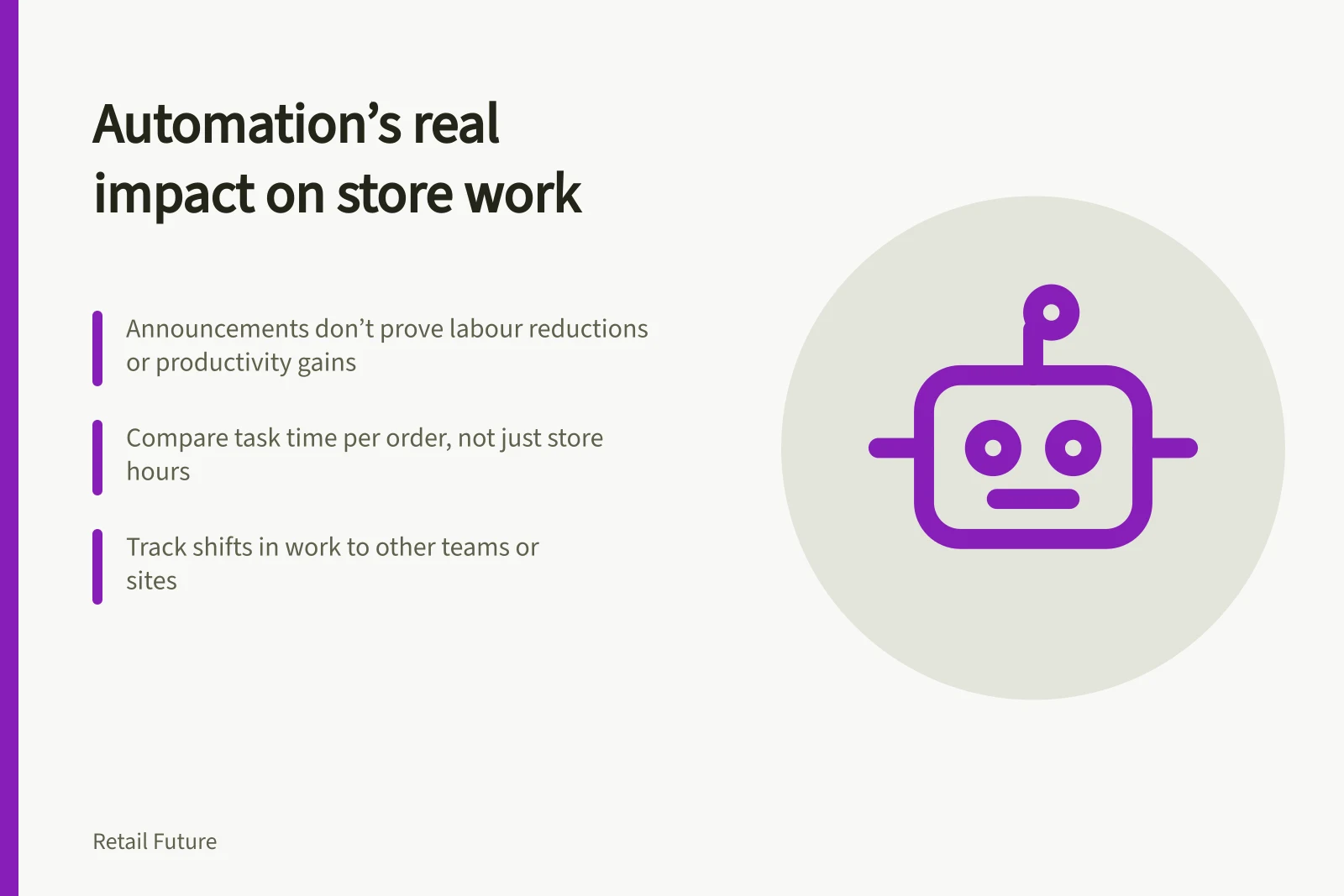
To assess a claim that automation changed store work, identify the task, affected locations and before-and-after measures. A rollout announcement can establish intended use. It cannot, on its own, establish fewer labour hours, higher productivity or better service.
Key Findings from Automation Impact Studies (Australia & Global)
- US retail jobs at risk due to automation
- 6 to 7.5 million
- Coles AI adoption announcement
- Accelerated with OpenAI
- Warehouse automation selection guide
- Practitioner’s perspective (ISM World, 2025)
- Automation impact on productivity
- Varies by task and context
Locate the task
Automation may support rostering, replenishment decisions, warehouse handling, order picking or a customer-facing process. These activities sit in different parts of a retail business.
A distribution-centre change may alter what reaches a store without replacing a task performed there. Roster software may change planning work without changing the number of people needed to serve customers.
The title of a Coles release, “Coles accelerates AI adoption in retail with OpenAI”, presents a company account of AI use. The announcement does not provide a controlled comparison of store labour hours or establish an employment effect.
Match evidence to the claim
| Evidence | What it can establish | What remains open |
|---|---|---|
| Announcement | Intended function and proposed scope | Routine use and operating effect |
| Deployment record | Where and when a tool began operating | Whether staff tasks changed |
| Comparable task and hour records | Changes in time spent on defined work | Work moved elsewhere or changes in quality |
| Service and full-cost measures | A broader operating result | Whether the tool caused the change |
For a local assessment, record the old and new workflows. Include supervision, error correction, maintenance, customer help and work transferred to another site or team. Otherwise a store-hour reduction may merely shift the work outside the store's ledger.
Use a consistent denominator
Compare time per completed unit of the same work, such as a defined type of order, alongside volume and service quality. Keep the range, trading hours, order mix and staffing policy visible. Fewer hours with more late or incorrect orders is a different outcome from fewer hours with stable service.
Where possible, compare suitable locations or periods and record other changes that could explain the result. A before-and-after movement alone does not prove causation. If public disclosures lack task-level hours or comparable service measures, the defensible conclusion is that a tool was announced or deployed; its effect on store work remains unmeasured in the available evidence.