Retail Economics
Reading workforce statistics with the right population
Interpret Australian retail workforce figures by separating people, filled jobs, total jobs and hours, with the right industry and reference period.
Before saying how many people work in Australian retail, identify the unit, industry population and reference period. People, filled jobs, total jobs and hours answer different questions. A difference between them is not necessarily a contradiction.
Choose the measure
| Question | Suitable measure | Mistake to avoid |
|---|---|---|
| How many people work in the industry? | Employed people in Retail trade under a named series | Treating every filled job as a different person |
| How many positions are occupied? | Filled jobs | Calling vacancies or total jobs workers |
| How much labour was supplied? | Hours actually worked | Assuming a stable people count means stable hours |
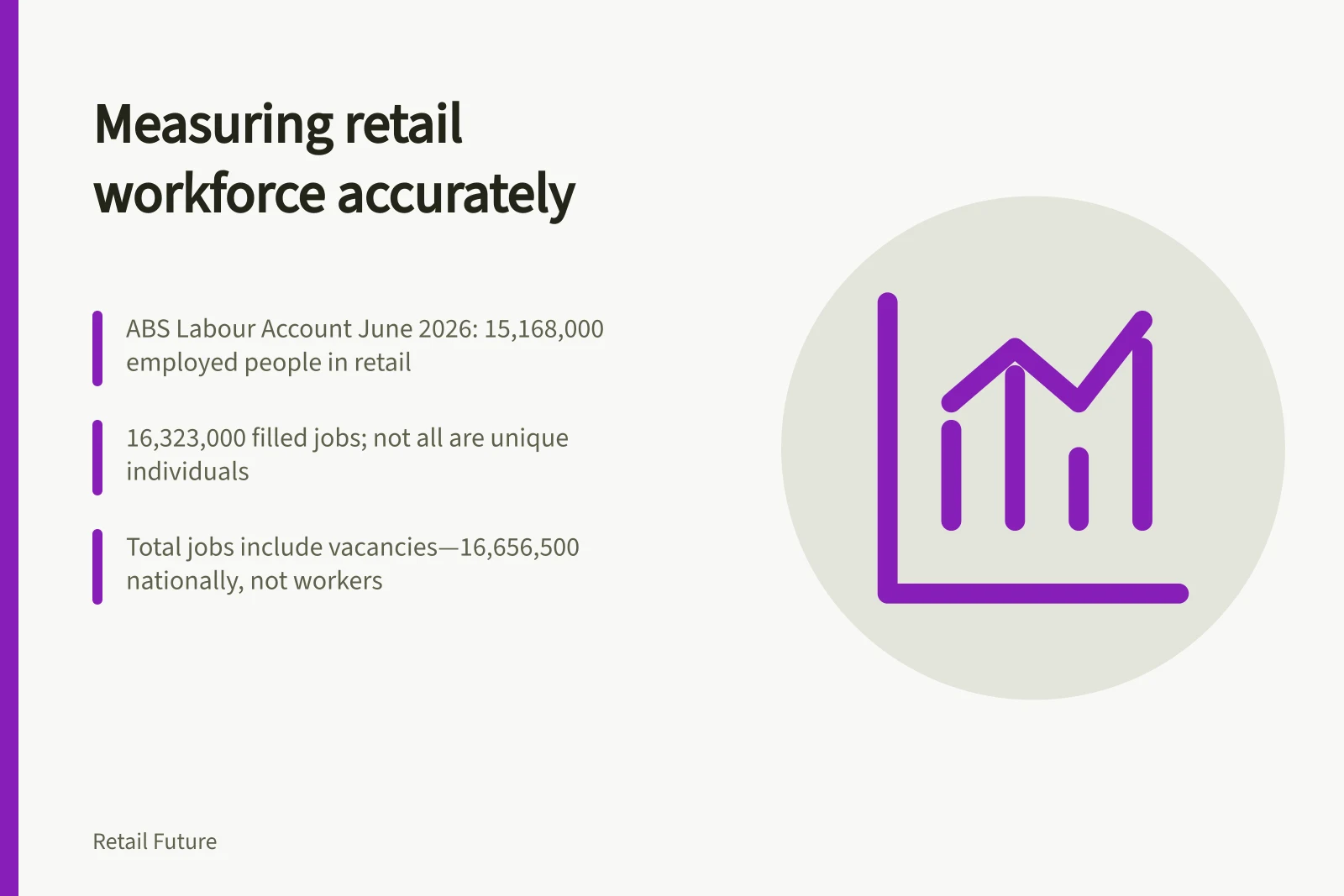
The Australian Bureau of Statistics (ABS) Labour Account June 2026 quarter release, seasonally adjusted, estimated 16,323,000 filled jobs, 15,168,000 employed people and 6,130.0 million hours actually worked nationally. Those national totals do not by themselves give a Retail trade figure; for retail-specific figures, use the relevant industry series and confirm the number against the source release. Labour Account industry estimates do not count only customer-facing store staff.
The same release estimated 16,656,500 total jobs nationally. That broader measure includes vacancies as well as filled jobs and should not be described as a count of workers.
Key Workforce Measures in Australian Retail: Understanding the Differences
National Labour Account Snapshot – June 2026 Quarter
Using Filled Jobs vs Employed People in Retail Analysis
- Pros of using 'Employed people' measure
- Reflects actual individuals working; useful for workforce planning and skills analysis
- Cons of using 'Employed people' measure
- Does not capture multiple job holders; may underrepresent total labour input
- Pros of using 'Filled jobs' measure
- Captures all occupied positions, including those held by people with multiple jobs
- Cons of using 'Filled jobs' measure
- May overstate workforce size if individuals hold multiple roles
Keep industry and occupation separate
Retail trade is an industry classification. A person in office, warehouse or management work for a business classified in the industry can be within its workforce; a sales occupation can also occur in a business classified elsewhere.
Check how each series assigns industry. The Labour Account combines the Labour Force Survey with unpublished Quarterly Business Indicator Survey data to improve its industry distribution estimates. Because the series can differ in scope and reference period, their figures should not be substituted for each other without checking the series definition.
The boundary matters for businesses casually called retail. Under ANZSIC, food and beverage services such as cafés are classified in Accommodation and Food Services, a separate division. Name the statistical series before deciding whether such activity is included.
Keep time and revisions visible
Reference periods can differ between series. Before comparing figures, check whether the series measures people and jobs at a point in time or hours over a period, and confirm the quarter or month used. The ABS recommends the Labour Account for analysing employed people and jobs by industry division and subdivision over time.
Record the series, industry, unit, quarter, adjustment basis and release date with every figure. The June 2026 Labour Account release notes that some industry-level series are under review and are not being published while the ABS modernises the Labour Force Survey. Check the release for the latest availability.
A bounded statement should name the series and population, for example: 'The ABS Labour Account estimated 16,323,000 filled jobs nationally in the June 2026 quarter, seasonally adjusted.' For a store roster, use that store's own paid and worked hours, roles and service activity. An industry figure cannot show who was on a particular shift.
How to Read Retail Workforce Statistics Correctly
- Identify the correct statistical series (e.g., ABS Labour Account)
- Confirm the industry classification (Retail trade under ANZSIC)
- Check the reference period (e.g., June 2026 quarter)
- Note whether data is seasonally adjusted
- Verify if the series is under review or provisional