Retail Economics
Understanding opening hours as an operating decision
Assess Australian store opening hours through local trading rules, marginal customer demand, staffing conditions and complete incremental cost.
Assess extra opening hours at the margin: can the store legally trade, what customer need would the added period serve, and would its additional gross profit and service benefit justify the full extra cost? Sales moved from another hour or branch are not all new sales for the retailer.
Check which hours are available
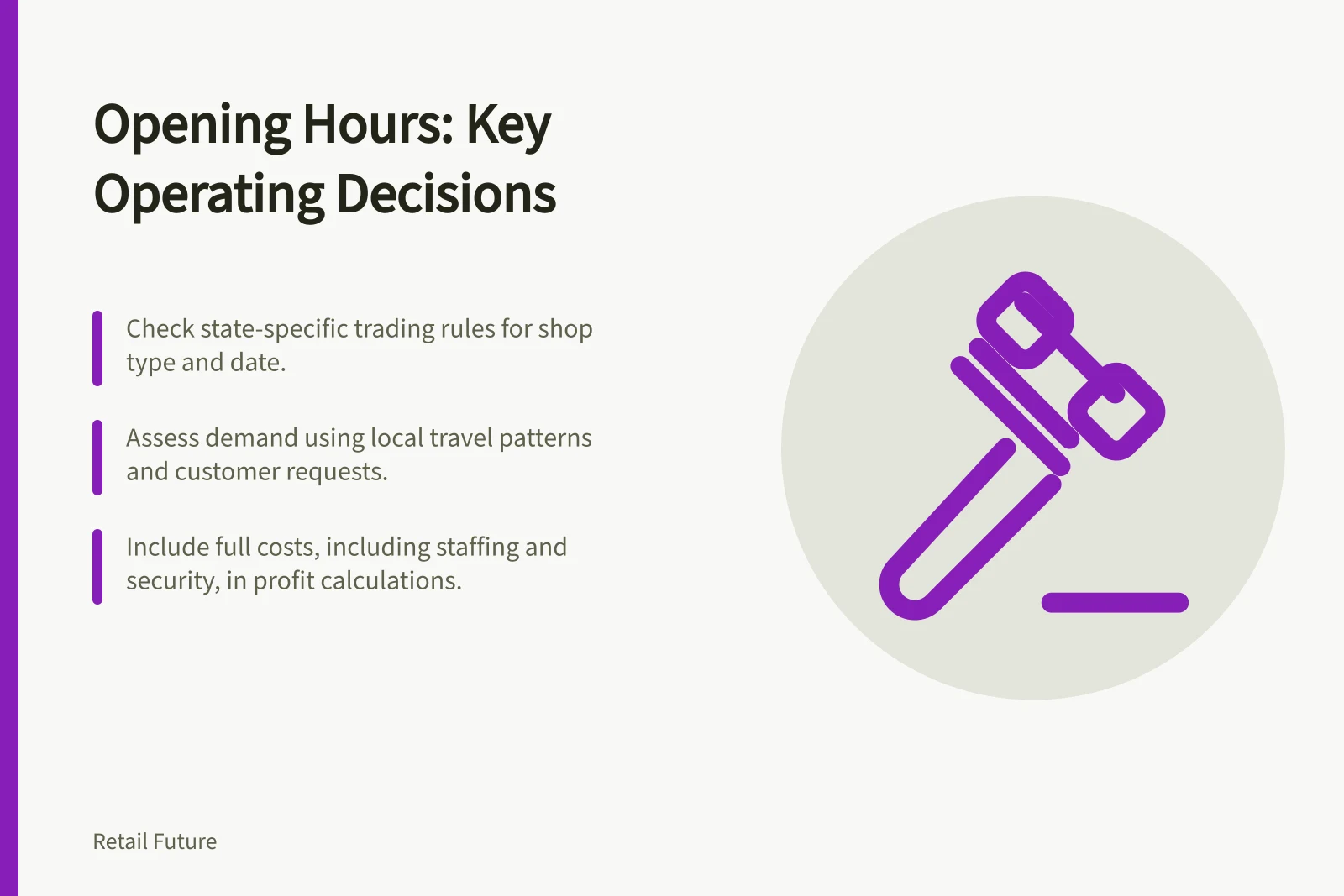
Australian trading rules depend on jurisdiction, location and shop type. Queensland distinguishes exempt, independent and non-exempt shops, with separate rules for Sundays and public holidays. Western Australia's guidance distinguishes general, small and special retail shops and describes regional variations.
Neither state's timetable is a national rule, and permission to open does not require a shop to use every available hour.
Check the rule for the premises, date and classification before setting a new schedule. Check employment conditions separately.
The General Retail Industry Award contains ordinary-hours, rostering and penalty-rate provisions for employees it covers; an enterprise agreement or another award may apply. Trading permission and staff pay answer different questions.
Trading Hours by Australian State: Key Differences
- QueenslandDistinguishes exempt, independent and non-exempt shops; separate rules for Sundays and public holidays.
- Western AustraliaDifferentiates general, small and special retail shops with regional variations in permitted hours.
Identify demand in the proposed period
Ask what customers could do in the extra hour and whether the relevant products and help would be available. For an existing store, review activity near current opening and closing times, customer requests and any local conditions that affect demand. The last open hour is an imperfect forecast for an untraded hour.
| Proposed change | Evidence to seek | Operating question |
|---|---|---|
| Open earlier | Requests near opening and relevant local travel patterns | Who prepares and covers the first customer period? |
| Close later | Activity near closing and unmet evening requests | Can stock, supervision and security support the offer? |
| Add a weekend period | Relevant local trips and permitted hours | What staffing conditions and complete shift costs apply? |
These are prompts for a location-level assessment, not findings that any particular hour will trade well.
Key Considerations When Extending Store Hours
- Staffing ConditionsPenalty rates apply under the General Retail Industry Award; enterprise agreements may vary.
- Customer Demand IndicatorsRequests near opening/closing times, local travel patterns, unmet evening needs.
- Operational CostsIncludes supervision, security, cleaning, utilities, and stock replenishment.
Count the complete change
Include preparation and closing work, breaks, supervision, cleaning, security, utilities and replenishment where they change. Estimate the gross profit from genuinely additional purchases and compare it with those incremental costs. Record purchases shifted from another hour, branch or channel separately; a shifted purchase may still improve convenience, but its full revenue is not a new network benefit.
A limited trial can define the hours, dates, service standard and review point in advance. Compare suitable periods and nearby branches where useful, while recording sales displacement and staffing effects.
A collection window or another narrower service may also meet a specific need. The decision belongs to that location, its customers and the rules that apply there.
Steps to Assess New Opening Hours
- Check local trading rules for premises, date and shop classification
- Review customer demand near proposed opening or closing times
- Estimate incremental gross profit from genuinely additional sales
- Include full costsstaffing, security, utilities, cleaning, replenishment
- Record shifted sales (from other hours, branches or channels)