Retail Economics
Part of Retail business economics
Gross margin versus operating profit in retail
See how retail gross margin differs from operating profit, work through the arithmetic and check expense definitions before comparing results.
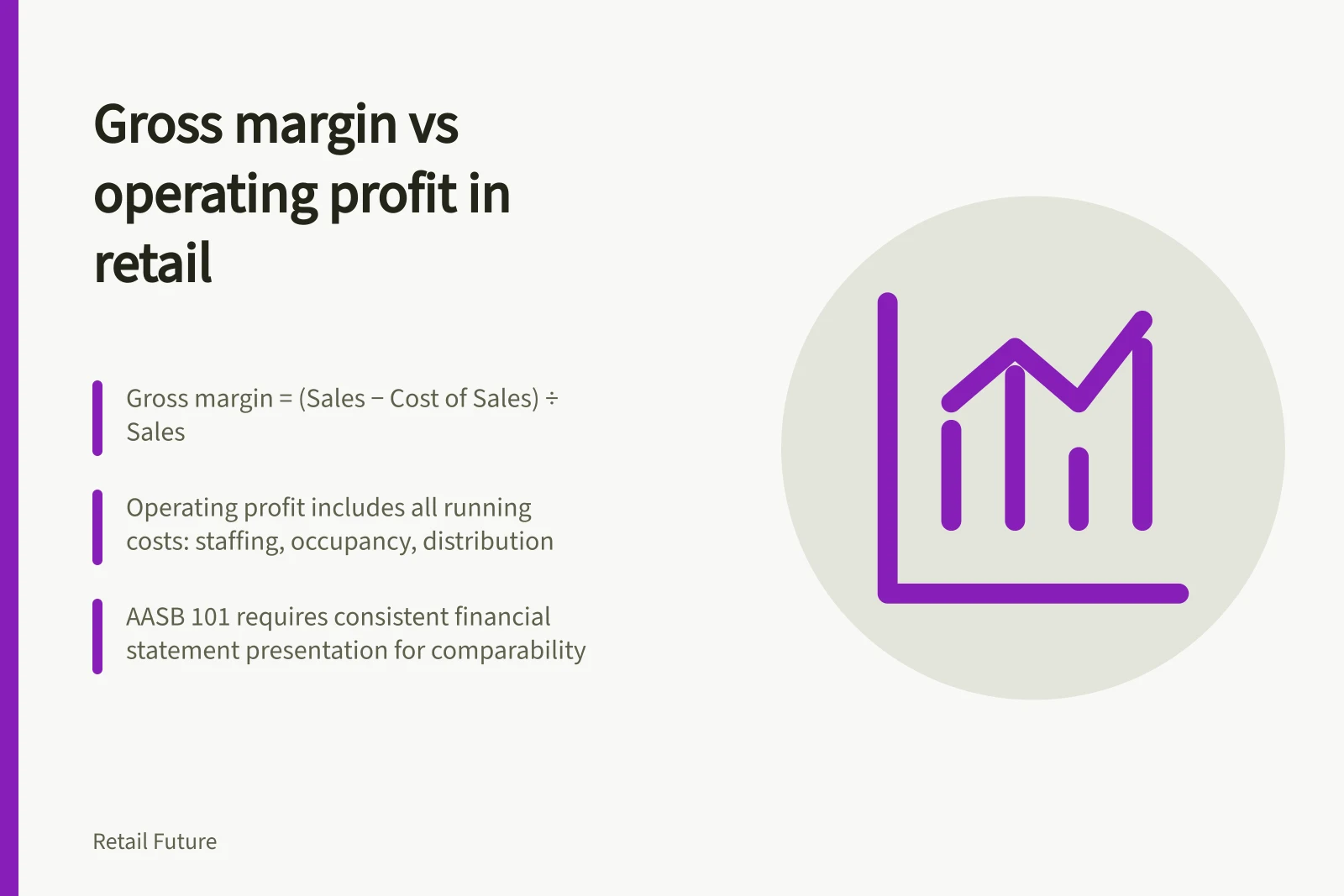
Gross margin is the share of sales left after cost of sales. Operating profit is what remains after further costs of running the business, using the retailer’s stated definition. A strong gross margin can coexist with a weak operating result when staffing, occupancy, distribution or other expenses absorb the difference.
Build the bridge from sales
Begin with sales and cost of sales for the same business and period. Gross profit is sales less cost of sales; gross margin is gross profit divided by sales.
Next identify the expenses between gross profit and the reported operating subtotal. Do not assume retailers classify freight, fulfilment, depreciation or stock losses in the same way.
AASB 101 prescribes the basis for presentation of general purpose financial statements to ensure comparability, and sets out overall requirements for presentation, guidelines for structure and minimum requirements for content.
Read the company’s notes and definition before comparing operating figures.
Consider an invented retailer with $1,000,000 in sales, $600,000 in cost of sales and $340,000 in other operating costs. Gross profit is $400,000, giving a 40% gross margin.
Operating profit on this simplified basis is $60,000, or 6% of sales. The example excludes financing costs and tax and is not a published retailer result.
| Simplified line | Hypothetical amount | Share of sales |
|---|---|---|
| Sales | $1,000,000 | 100% |
| Cost of sales | $600,000 | 60% |
| Gross profit | $400,000 | 40% |
| Other operating costs | $340,000 | 34% |
| Operating profit on the stated basis | $60,000 | 6% |
Gross Margin vs Operating Profit: Key Differences in Retail
- DefinitionGross margin is sales minus cost of sales, expressed as a percentage of sales. Operating profit is gross profit minus all other operating expenses (e.g., staffing, occupancy, distribution).
- Calculation BasisGross margin depends only on sales and cost of sales. Operating profit includes additional costs such as freight, depreciation, and stock losses.
- PurposeGross margin measures product profitability. Operating profit measures overall business efficiency after all operational costs.
Why a margin can improve while profit falls
Suppose the business lifts gross margin through a different product mix but adds staff hours and delivery costs. Gross profit may rise while operating profit falls.
The reverse is also possible: a lower gross margin may accompany enough extra sales or lower operating costs to improve profit. The bridge identifies which line moved; further evidence is needed to explain why.
Inventory accounting matters too. Under AASB 102, the carrying amount of inventory sold is recognised as an expense when the related revenue is recognised.
Write-downs and inventory losses are expenses. Check where a retailer presents these items before comparing its gross margins across periods or with another business.
Read percentages with dollar amounts. A small category with a high gross margin may contribute fewer dollars towards operating costs than a larger, lower-margin category.
Extra sales at a thin margin may add work without enough gross profit to cover it.
Compare like with like
Check the reporting segment, period, expense classification and treatment of significant items. Separate a group result from an individual store result; group operating profit can include income and costs that cannot be assigned cleanly to one shop.
For a proposed change, estimate its extra gross-profit dollars and the operating costs it adds or removes. A promotion has product-margin and service costs; a new service has fulfilment and support costs.
Gross margin shows what remains after the stated cost of sales. Operating profit shows whether that amount covered the further costs within the reported business boundary.
Key Steps for Comparing Gross Margin and Operating Profit
- Verify the reporting period and segment (e.g., group vs store-level)
- Review the company’s notes on expense classification and significant items
- Check where inventory write-downs or stock losses are reported
- Compare like with likeavoid mixing different business models or geographies
- Estimate incremental gross-profit dollars and associated operating costs for proposed changes (e.g., promotions, new services)