Retail Economics
Part of Retail business economics
Sales per square metre and its limitations
Calculate retail sales per square metre, check which sales and floor area are counted, and see why the result is not a profit measure.
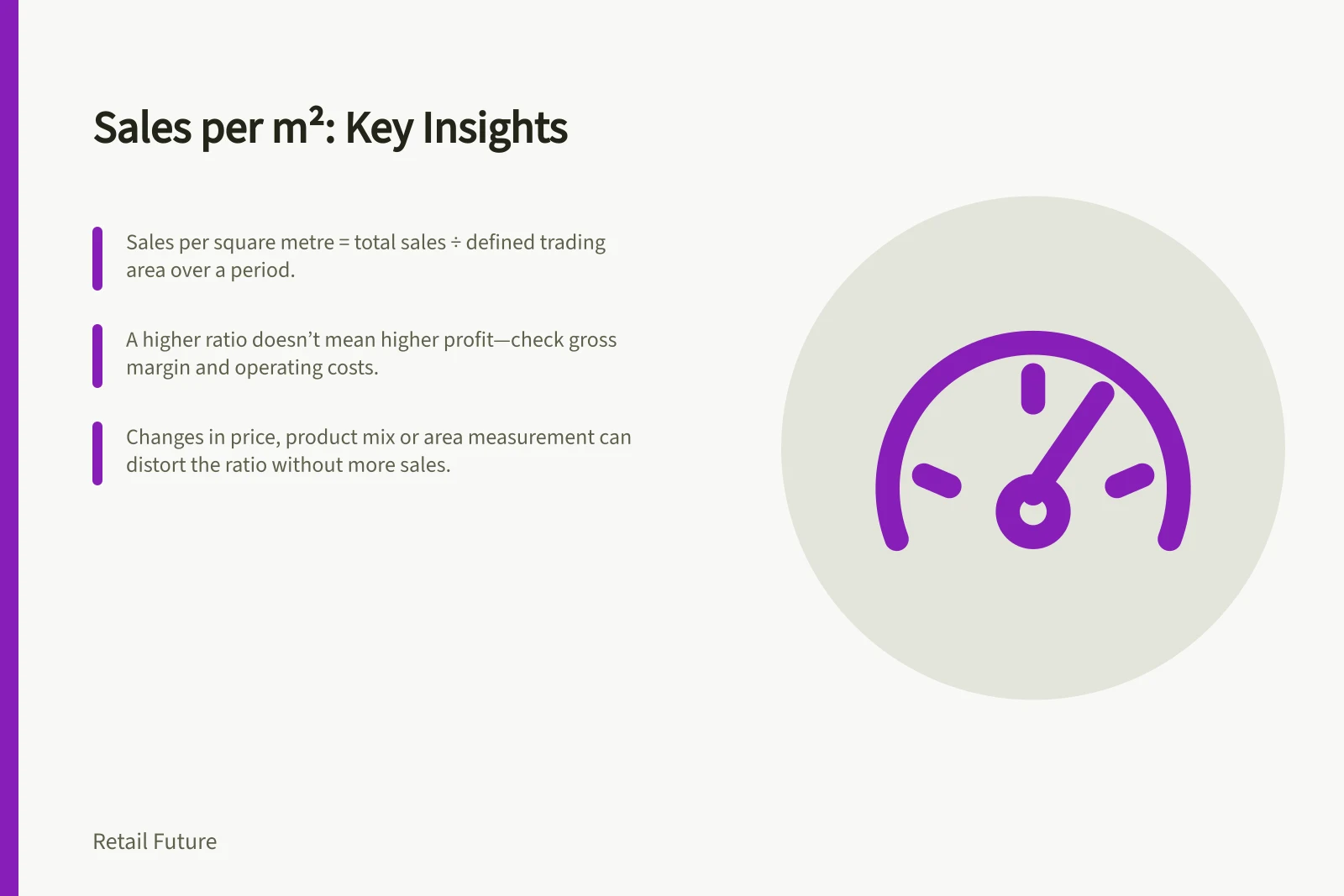
Sales per square metre is sales divided by a defined floor area for a defined period. A higher result means greater sales density under that definition. It does not show that a store earns more profit, so read it alongside margin and the cost of operating the space.
Define sales and area
Use a sales measure that belongs with the area being assessed. For one shop, decide how to treat online orders picked or collected there and orders delivered from elsewhere. Record returns and the trading period. A full year and a three-month opening period are not directly comparable.
The denominator may be customer-facing selling area, total leased area or average trading area. These choices produce different ratios.
Some retailers publish their own definition, and such a published company measure is not a universal rule or a store-only ratio.
Average area may be more useful than closing area when a floorplan changed during the period. Record how stockrooms, collection points and temporary closures are treated.
Key considerations when calculating sales per square metre in Australian retail
- Sales measureMust align with area definition – include or exclude online collections and deliveries as defined
- Area denominatorCustomer-facing area, total leased area, or average trading area – consistency is key
- Time periodFull year vs. partial period – not directly comparable
- Stockroom & temporary closuresMust be consistently excluded or included in area calculation
Work through the arithmetic
Suppose a shop records $900,000 in annual sales from 300 m² of defined trading area. Its sales density is $3,000 per m² for that year.
Another shop records $800,000 from 200 m², or $4,000 per m². These invented shops illustrate the calculation, not actual Australian retailer results.
The second shop has higher density but lower total sales. At a hypothetical 40% gross margin, the first shop has $360,000 of gross profit and the second $320,000.
If their operating costs on the same stated basis are $300,000 and $290,000 respectively, their contributions are $60,000 and $30,000. In this illustration, the denser shop contributes less. Those simplified contributions are not a complete company operating-profit measure.
Know what the ratio misses
Sales density does not show product margin, rent, staff costs, utilities or the cost of serving orders.
A compact shop can appear productive because it stocks mainly fast-moving lines, while a larger location supports a broader range or collection service. Whether either format is worthwhile depends on its role and full costs.
The ratio can also change without more units being sold. A price rise, different product mix or smaller measured area can raise it. A stockout can depress sales even where demand exists. Check these changes before treating movement in the ratio as improved or weaker use of space.
Pros and cons of using sales per square metre in retail decision-making
- ProsHelps identify high-performing space; useful for comparing similar store formats over time
- ConsDoes not reflect profitability, rent, staffing, or product margins; can be distorted by price changes or area adjustments
Use it for a space decision
Compare similar formats over similar periods, using the same treatment of sales and area.
Then place sales per square metre beside gross profit per square metre, occupancy cost, operating contribution and relevant availability measures.
If a proposed floorplan reduces selling area, check whether customers buy more or whether the ratio rose only because the denominator shrank.
The metric helps identify space that generates sales. It cannot, by itself, decide whether to shrink a shop, change its range or sign a lease.