Retail Economics
Part of Retail data and research methods
Recording sample and period limitations in retail analysis
Record the population, coverage, dates, adjustment basis and source version beside a retail finding.
Put the population and dates beside a retail finding so they remain visible when it is shared. A reader should be able to tell who or what was measured, when it happened and which activity the result misses.
Describe the observed population
Start with the group the question concerns, then describe the group actually observed. For a survey, record eligibility, recruitment, the number answering the specific question and any weighting. For a transaction extract, record included stores, channels, products, payment routes and customer identifiers. For a published industry series, use its stated business population and exclusions.
A large sample is not automatically complete. The ABS distinguishes sampling error from coverage, non-response and response errors. Increasing a suitably drawn sample can reduce sampling error; it does not add people or businesses that had no route into the data.
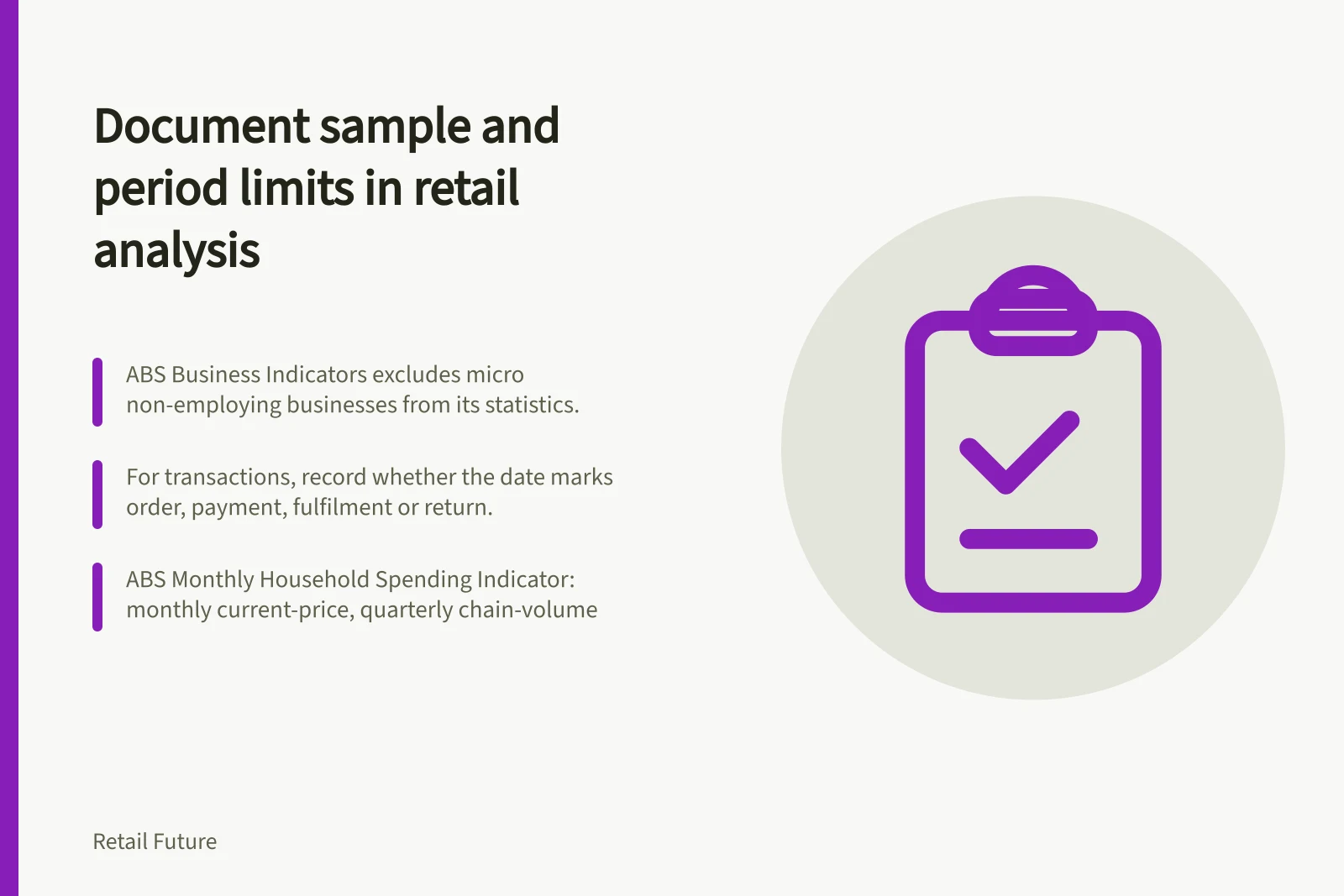
For example, Business Indicators, Australia excludes micro non-employing businesses from its statistics. It also does not collect inventories data from all businesses within its scope. These are specific limits of that publication, not rules for every retail source.
What to record about the observed population
- SurveyEligibility, recruitment, the number answering the specific question and any weighting
- Transaction extractIncluded stores, channels, products, payment routes and customer identifiers
- Published industry seriesThe stated business population and the exclusions applied to it
- CoverageAny people or businesses that had no route into the data
- Error typeSampling error reported separately from coverage, non-response and response error
Stated limits of Business Indicators, Australia
- Micro non-employing businessesExcluded from the statistics
- Inventories dataNot collected from all businesses within the publication's scope
Record the period and the version
Keep the reference period, when the activity occurred, separate from the release or extraction date, when the figure was available to the analyst. For a survey, add field dates and any recall period. For transactions, specify whether the date marks an order, payment, fulfilment or return. Different choices can place activity in different months.
Record the unit and adjustment basis too. Original and seasonally adjusted figures should be labelled. The ABS Monthly Household Spending Indicator publishes monthly current-price estimates and quarterly chain-volume estimates; a monthly dollar movement cannot be described as a monthly volume movement.
Field / Entry to retain
- Population
- Intended group and observed respondents, customers or businesses
- Coverage
- Included locations, channels, payment routes or areas
- Period
- Start and end dates, plus the event date used
- Basis
- Unit, price treatment and seasonal adjustment
- Version
- Publication release or internal extraction date
Reference period versus release or extraction date
- Reference periodWhen the activity occurred. For surveys, add field dates and any recall period. For transactions, state whether the date marks an order, a payment, a fulfilment or a return.
- Release or extraction dateWhen the figure became available to the analyst, whether as a publication release or an internal extract.
Adjustment basis in the Monthly Household Spending Indicator
- Monthly estimates
- Current price
- Quarterly estimates
- Chain volume
Attach a limitation to the finding
A reporting sentence might say: “The result covers recorded purchases at the included stores during the stated quarter; purchases elsewhere are outside the extract.” This is an example, not an observed retailer result. If customer identification or coverage is unknown, state that uncertainty.
Before comparing periods, check for changes in store network, recruitment, question wording, product classification or transaction system. Document a defensible adjustment where possible; otherwise describe the observations separately.
Before comparing two periods
- Check the store network and recruitmentHas the number or mix of included stores, channels or recruited respondents changed?
- Check definitions and classificationHas question wording or product classification changed?
- Check the transaction systemHas the system recording orders, payments, fulfilments or returns changed?
- Document a defensible adjustmentWhere one exists, record it beside the finding.
- Otherwise describe the observations separatelyDo not present a like-for-like comparison the data cannot support.