Market Analysis
Part of Understanding the Australian retail market
Retail sales versus retailer revenue: reading the measures
Understand why Australian industry turnover, a retailer’s sales measure and reported revenue can differ, and how to compare them.
“Retail sales” may refer to turnover across a defined group of businesses. “Retailer revenue” usually refers to income recognised by one company under its accounting policies. Before comparing them, identify who is counted, which activities are included, the period and the treatment of GST.
Identify each number
| Measure | Check first | Why it matters |
|---|---|---|
| Industry retail turnover | Publication, business population and included activities | It estimates activity across an industry, not one company’s accounts. |
| A retailer’s sales measure | The company’s definition and reporting segment | An operating measure may differ from statutory revenue. |
| Reported revenue | Financial statements and accounting policy | Recognition can depend on whether the company acts as principal or agent. |
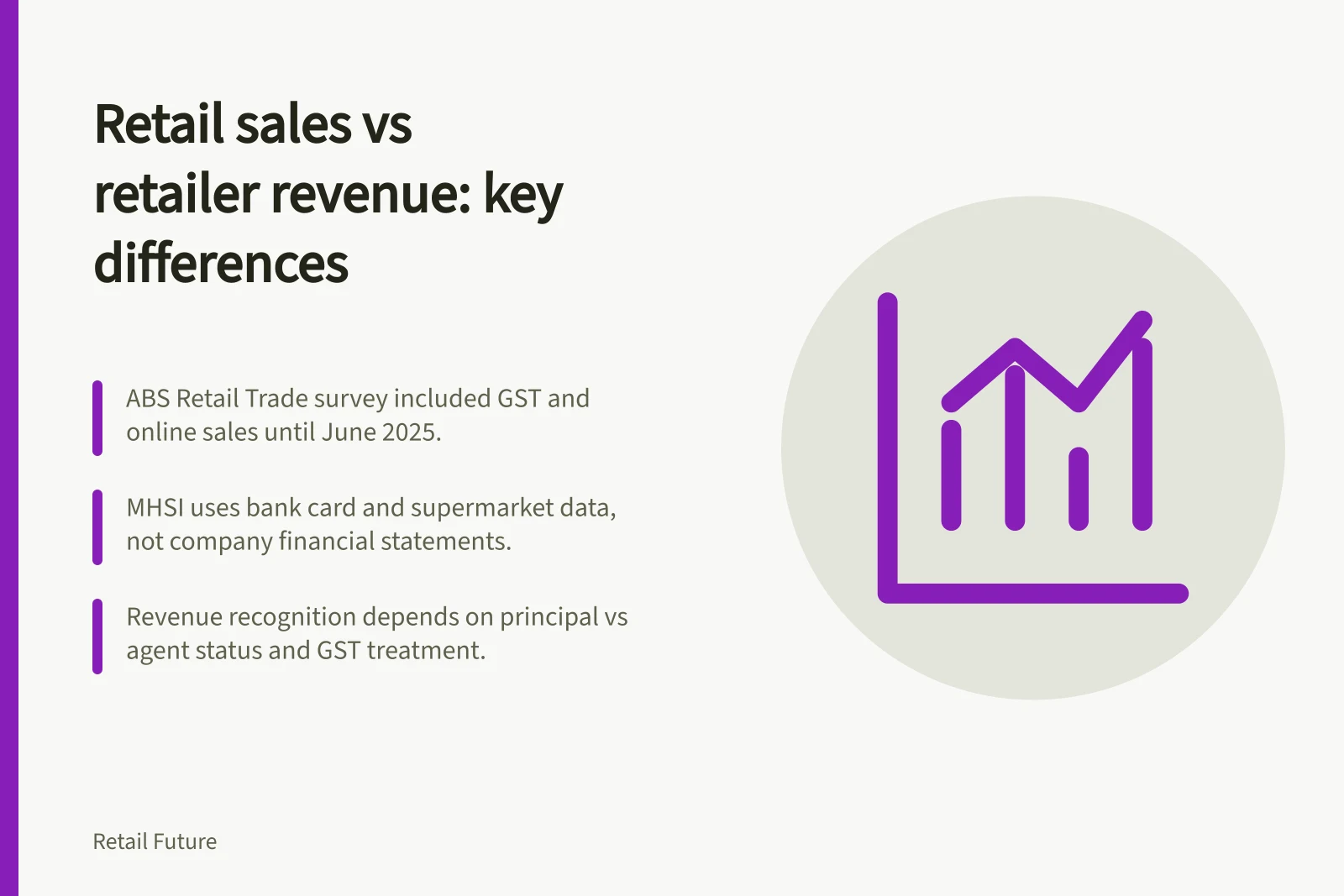
The former ABS Retail Trade, Australia survey measured turnover for an in-scope population of businesses. Turnover included retail and online sales, certain wholesale sales, takings from meals and repairs, commissions and GST. It was not a sum of every listed retailer’s reported revenue.
The ABS ended that publication after June 2025. The Monthly Household Spending Indicator (MHSI) is derived from bank card transactions, supermarket transactions and new vehicle sales data.
The MHSI is benchmarked to annual Household Final Consumption Expenditure (HFCE) and adjusted monthly to cover data gaps such as cash spending. Its scope differs from the Retail Trade turnover estimates, and its data sources do not capture some spending, including Australian residents’ spending outside Australia.
Key Changes in Australian Retail Data Reporting
- End of ABS Retail Trade Survey
- June 2025
- New Indicator Introduced
- Monthly Household Spending Indicator (MHSI)
- MHSI Data Sources
- Bank card transactions, supermarket data, new vehicle sales
Check the accounting boundary
In general, amounts collected on behalf of third parties are not treated as a company’s revenue. When another party helps provide a good or service, a company that controls the specified good or service before transfer acts as principal and recognises gross consideration. An agent that arranges the supply recognises its fee or commission.
For a marketplace, payments handled through the platform therefore need not equal the platform’s recognised revenue. The treatment depends on the transaction and the company’s disclosed policy; the word “sales” cannot settle it.
GST is another boundary to check: historical ABS Retail Trade survey turnover included GST. Do not assume another sales or revenue measure handles GST the same way without checking its methodology.
Implications of Principal vs Agent Treatment in Retail Platforms
- Pros: Principal Role
- Recognises gross consideration; reflects full control over goods/services before transfer.
- Cons: Agent Role
- Only recognises commission or fee; does not include third-party payments.
Make a defensible comparison
- Name the exact industry series and company metric.
- Align the periods and Australian geographic scope.
- Check whether the company metric includes other countries, wholesale activity, services or businesses outside the chosen industry.
- Record GST treatment and any relevant principal-versus-agent policy.
- Compare growth only where the remaining coverage is sufficiently close, and state the differences that remain.
Do not divide a retailer’s revenue by an unmatched industry total and present the result as market share. Even a reasonably aligned growth comparison can reflect prices, product mix, acquisitions or reporting changes. State what each measure shows and how far the comparison supports the conclusion.