Scenario Outlook
Part of Retail outlook and scenario analysis
Building retail scenarios without presenting them as forecasts
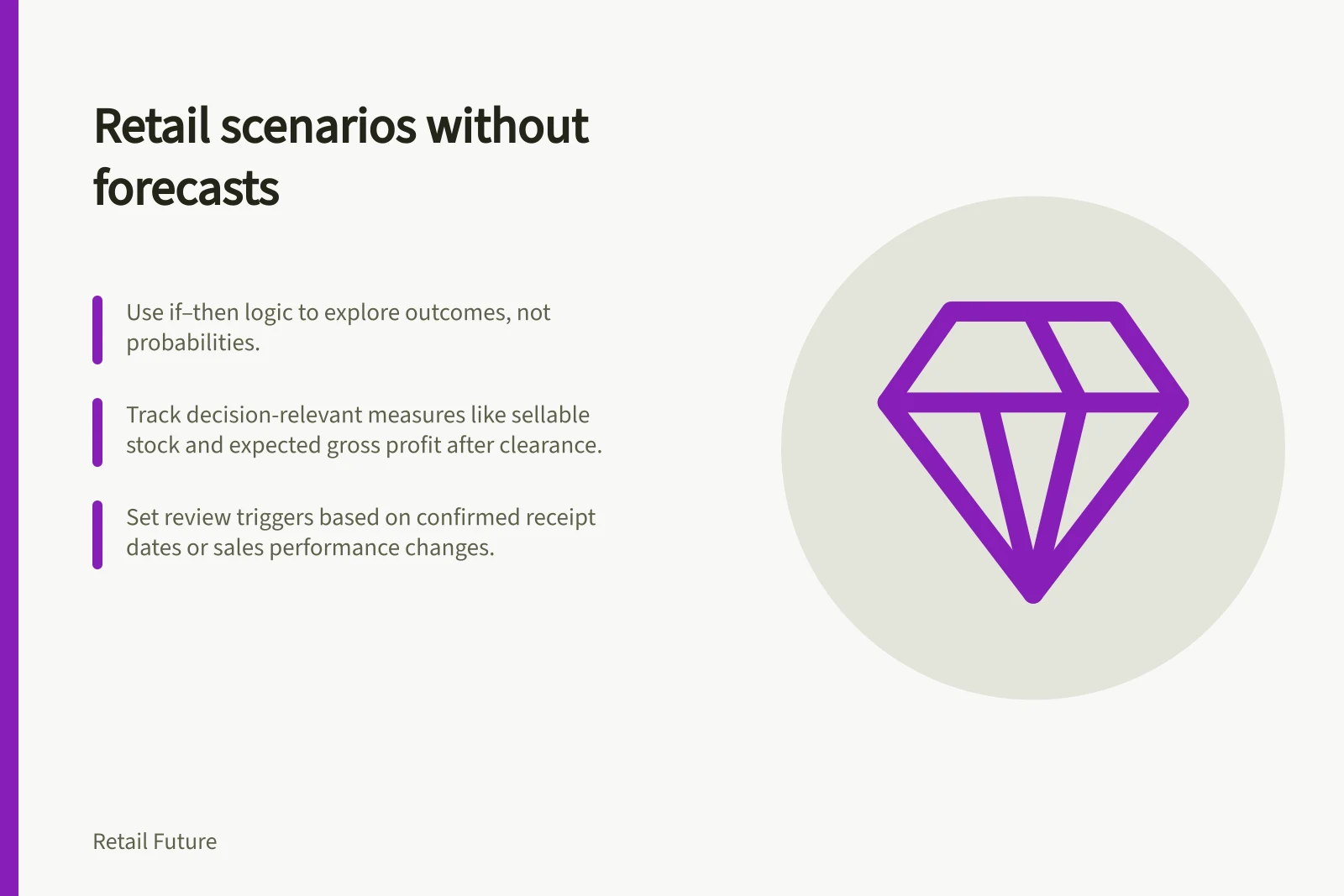
Write conditional retail scenarios around a real decision, with explicit drivers, consequences and review triggers.
Build a retail scenario as an if–then account: if a specified condition changes, what could happen to the business and what would you do? A plausible branch does not establish how likely it is. Describe it as a forecast only if a forecast has actually been made and its basis documented.
Begin with one decision
Suppose an Australian retailer must decide whether to place a second order of seasonal homewares. The decision has a date, a product group, a selling window and costs attached to ordering too much or too little. This case is hypothetical.
Record the starting position using measures relevant to that order: units sold while the products were available, sellable stock, accepted supplier orders, expected receipt dates and likely gross profit after clearance. Use only decision-relevant internal measures; include an external measure only if it bears on the choice.
Change conditions consistently
Choose two or three uncertain drivers that could materially alter the order. Here they are demand during the remaining selling window and reliability of the next delivery. Hold the known starting stock and decision deadline constant across the branches so they can be compared.
| Branch | Conditional story | Order question |
|---|---|---|
| Demand holds; delivery is reliable | Available-stock sales remain near plan and another order arrives within the selling window. | Could the order protect availability while covering its cost? |
| Demand weakens | Sales of available products slow while stock continues to arrive. | Should the order be reduced or deferred, given clearance risk? |
| Delivery slips | Demand persists but the order may arrive too late to sell well. | Is a smaller, earlier or alternative supply option viable? |
Show the reasoning
For each branch, write the driver, first measurable effect, business consequence and possible response. A delivery delay may reduce selling days, but it does not automatically cause lost sales. Existing stock, substitutes and customers' willingness to wait affect the outcome. If a branch uses numbers, show the inputs and calculation. Do not attach an unexplained probability or call a chosen midpoint the expected result.
State when a branch needs review
A usable statement could be: “If the supplier's confirmed receipt moves beyond the range's final useful selling weeks, review the second order against remaining demand and clearance value before committing.” This is a proposed rule. It is not a claim that a delay occurred.
Add the observation date, decision owner and action that can still be changed. Set a review trigger for each branch, such as a confirmed receipt date, a change in available-stock sales, or a shortened selling window.