Market Analysis
Part of Retail outlook and scenario analysis
Testing a retail hypothesis against later observations
Set a measurable retail hypothesis before later data arrives, then check eligibility, results and alternative explanations.
Write a retail hypothesis and its challenge condition before examining the later period. Then compare the result using the same population, measure and time horizon. A result consistent with the prediction can support it; it does not prove the proposed cause.
Write a claim that can be challenged
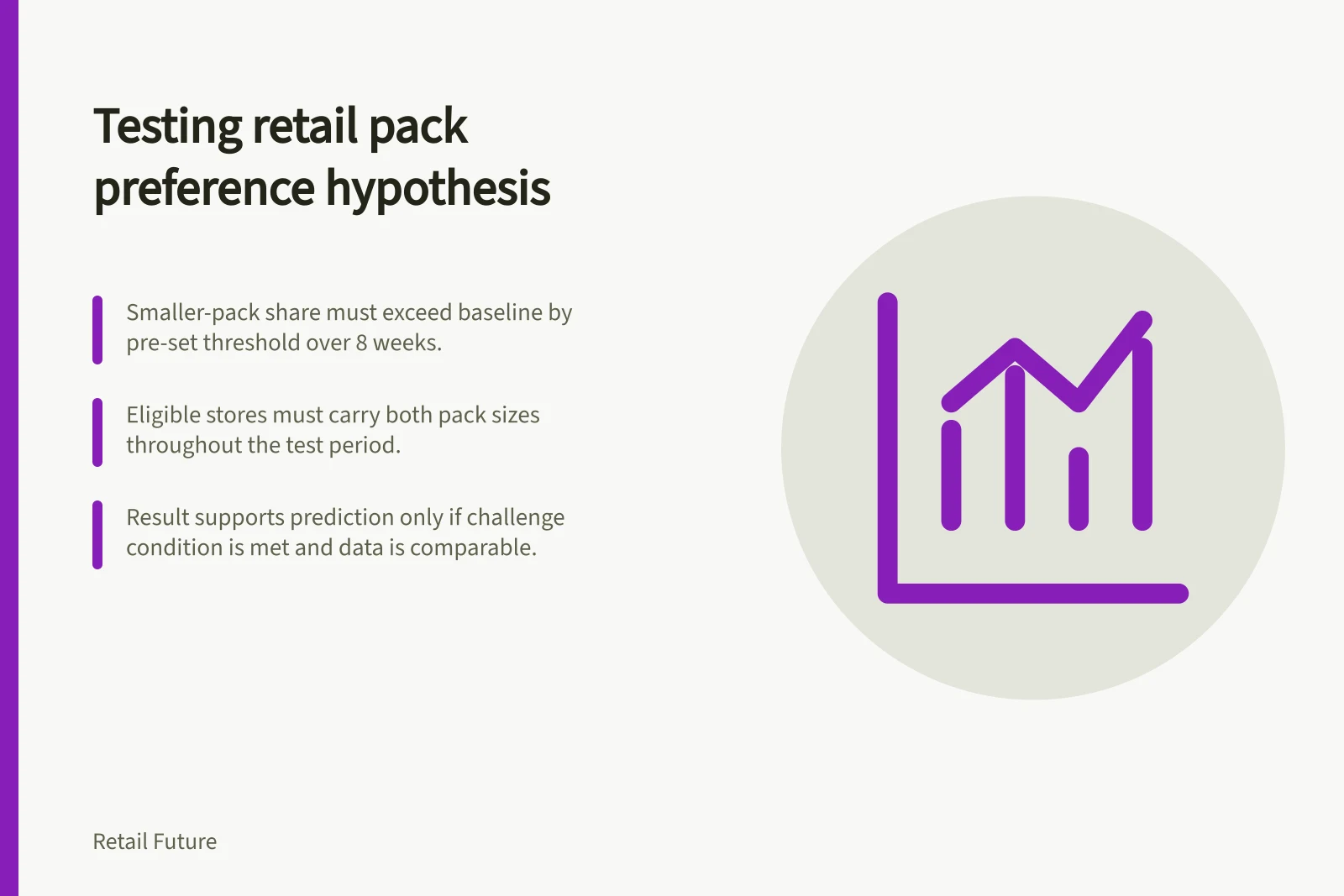
“Shoppers will prefer smaller packs” is too loose to test. A hypothetical retailer could instead propose a claim. It reads: “Among eligible stores carrying both pack sizes, the smaller pack's share of units sold across the two sizes in the next eight comparable trading weeks will exceed its share in the preceding eight weeks.”
The claim defines the products, stores, measure, periods and availability condition. It still needs a pre-set rule for what difference is large enough to matter for the decision.
Before the later weeks begin, save the baseline extract and write down the calculation, eligible stores and weeks, comparison rule, decision threshold and action the result would inform. If these rules are selected after seeing the outcome, describe the work as an exploratory review rather than a pre-set test.
Keep the later observation comparable
When the period ends, check whether both sizes were available and whether the same stores and channels were covered. Record changes in price, promotions, pack specifications and range. Report missing records. If one size was often out of stock, sales share cannot cleanly test preference because shoppers did not have the same choice.
| Item | Record before the period | Check afterward |
|---|---|---|
| Measure | Smaller-pack share of units sold across the two sizes | Calculate it using the same rule. |
| Eligibility | Stores and weeks with both sizes available | Report which stores and weeks qualified. |
| Challenge condition | The pre-set minimum change is not reached | Report whether it was reached. |
| Other explanations | Price, promotion and range could change | Report what changed. |
If too few eligible weeks remain, report that the planned comparison could not be made rather than treating the reduced record as decisive.
Pre-Test vs Post-Test Conditions
- Measure
- Smaller-pack share of units sold across two sizes
- Eligibility
- Stores and weeks with both pack sizes available
- Challenge Condition
- Pre-set minimum change not reached
- Other Explanations
- Price, promotion, or range changes reported
Separate the result from its explanation
If the smaller-pack share rises enough to meet the pre-set rule, the defined sales pattern supports the prediction under the recorded conditions. It does not establish why customers chose that pack. Prices, promotions, customer mix and purchases outside the retailer may matter. If the threshold is not met, the specific prediction has not held for this period and population; that does not settle every future period.
For this pack-level test, the evidence needed is the hypothetical retailer's own eligible pack sales and availability records for the defined stores and weeks. Broader published spending data may provide context, but it cannot substitute for those records.
Preserve the test record
Keep the dated hypothesis, baseline and later extract versions, exclusions, result and decision together. If a source is revised, recalculate and show whether the interpretation changes; an internal analysis likewise needs a traceable data version.
Conclude whether the result supports the defined prediction, challenges it or cannot test it because coverage or measurement failed. That conclusion should follow the rule written before the later observations arrived.
Key Metrics for Hypothesis Testing
- Test Period
- 8 trading weeks after intervention
- Eligible Stores
- Stores carrying both pack sizes during both periods
- Data Preservation
- All versions archived with timestamps