Market Analysis
Part of Retail outlook and scenario analysis
Separating confirmed changes from speculative trends
Classify retail observations, completed actions, plans and interpretations before calling a change a trend.
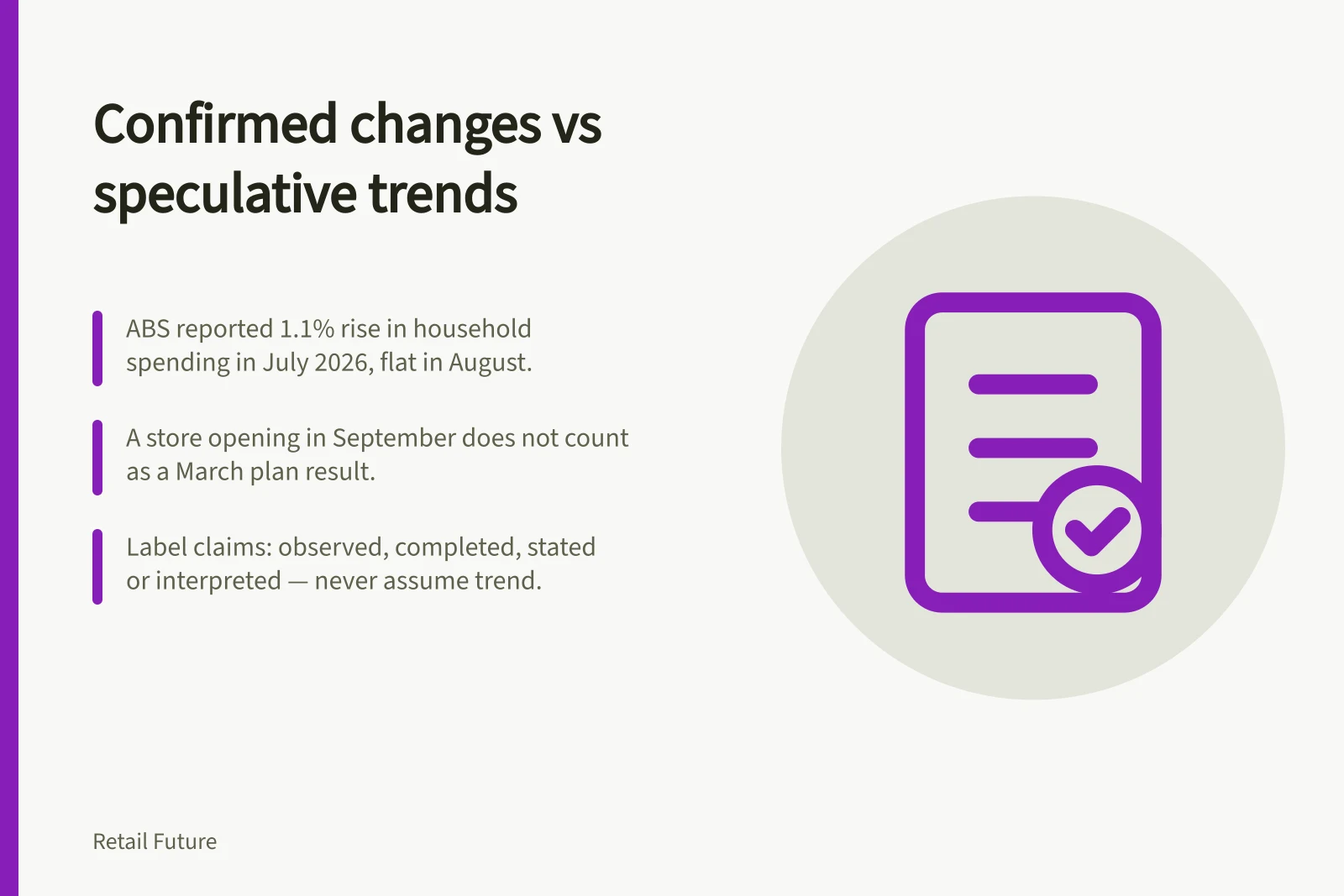
Call a retail change confirmed only at the level observed. A published movement in household spending, an announced store plan and a completed opening are different claims. None alone confirms a lasting trend in customer behaviour.
Label what the evidence establishes
| Claim status | What the record establishes | Suitable wording |
|---|---|---|
| Observed result | A defined measure changed in a stated period. | “The published measure rose” or “fell”. |
| Completed action | An event such as an opening or system launch occurred. | “The retailer opened” or “launched”. |
| Stated plan | An organisation intends to act later. | “The retailer plans” or “expects”. |
| Interpretation or possibility | An explanation or future path is proposed. | “This may indicate” or “if this continues”. |
New evidence can change a claim's status. Keep the dates attached: a plan reported in March does not become a March result because a store opens in September. The labels are an editorial aid, not an ABS classification.
Read a spending result narrowly
The Australian Bureau of Statistics (ABS) reported that total household spending at current prices, seasonally adjusted, rose 1.1% in July 2026 from June, then remained flat at 0.0% in August from July. Those are two confirmed monthly movements in published national total household spending.
Current-price spending reflects prices and measured volume, and the product mix can also matter. The ABS publishes quarterly chain-volume estimates of household spending; monthly MHSI outputs cover nine COICOP divisions. Its estimates may be revised. Keep the category, adjustment basis, comparison period and release date beside the observation.
The ABS methodology distinguishes the Monthly Household Spending Indicator from Retail Trade turnover estimates for retail businesses. A household spending result should not become a claim about an industry or particular chain without suitable evidence.
Monthly Household Spending Change: July and August 2026
- July 2026 (vs June 2026)1.1
- August 2026 (vs July 2026)0
Key Facts from ABS Monthly Household Spending Indicator – August 2026
- MeasureTotal household spending at current prices, seasonally adjusted
- July 2026 change↑ 1.1%
- August 2026 change→ 0.0%
- Release date1 October 2026
Keep the wider claim provisional
If the intended statement is “clothing demand is weakening”, define it. Specify the products, customers, geography, measure and duration it refers to. More comparable observations may support a pattern. Retailer units sold while stock was available may help with a narrower business decision. Price, range and stock changes remain possible explanations for a sales movement.
For the ABS example, an appropriately bounded statement is: “National current-price, seasonally adjusted household spending rose in July and was flat in August; these two months do not establish a persistent direction.” A single observation can prompt a question, but its status should remain visible until the wider claim has evidence.
For each outward-facing claim, retain the source and date, exact observation or plan, proposed interpretation and remaining unknown. Update the wording when later releases or company disclosures change what is established.