Shopper Research
Part of Retail formats and customer behaviour
Evaluating evidence about changing shopping habits
Check whether evidence shows a change in Australian shopping habits by matching behaviour, population, period and data coverage.
To establish that a shopping habit changed, compare the same defined behaviour across suitable periods. Store visits, online orders, purchase frequency, basket size and stated channel preference are different measures. A change in one does not establish a change in the others.
Make the claim measurable
“Customers are shopping online more” leaves too much unspecified. Name the people, category, place, dates and measure. For example: the share of a defined retailer’s customers who placed at least one online order in each of two comparable periods. Decide whether the question concerns participation, number of orders, dollars spent or share of total spending.
Customers can use both channels. More online orders need not mean fewer store visits; the same shopper may use different routes for different purchases.
Match evidence to what it records
| Evidence | Can help show | Does not establish alone |
|---|---|---|
| Repeated shopper survey | Change in reported behaviour or preference among comparable respondents | Completed transactions |
| Transaction or order records | Change in purchases within the recorded business and channels | Why customers chose a route, or purchases outside coverage |
| Store-visit counts | Change in recorded visits at measured locations | Whether visitors bought anything |
| Published industry series | Movement in its defined spending or turnover measure | A particular retailer’s customer journey |
Keep each measure’s definition and collection method beside the result. The ABS’s historical Retail Trade online sales measure included online sales from store-based and non-store-based retailers, except non-employing and non-resident businesses.
The Retail Trade publication stopped on 31 July 2025. A chart combining it with the Monthly Household Spending Indicator (MHSI) needs a method check before it is treated as one continuous series.
The ABS says the MHSI is derived from bank transactions, supermarket transactions and new vehicle sales data. Its scope varies from Retail Trade turnover estimates.
Read a headline within its population
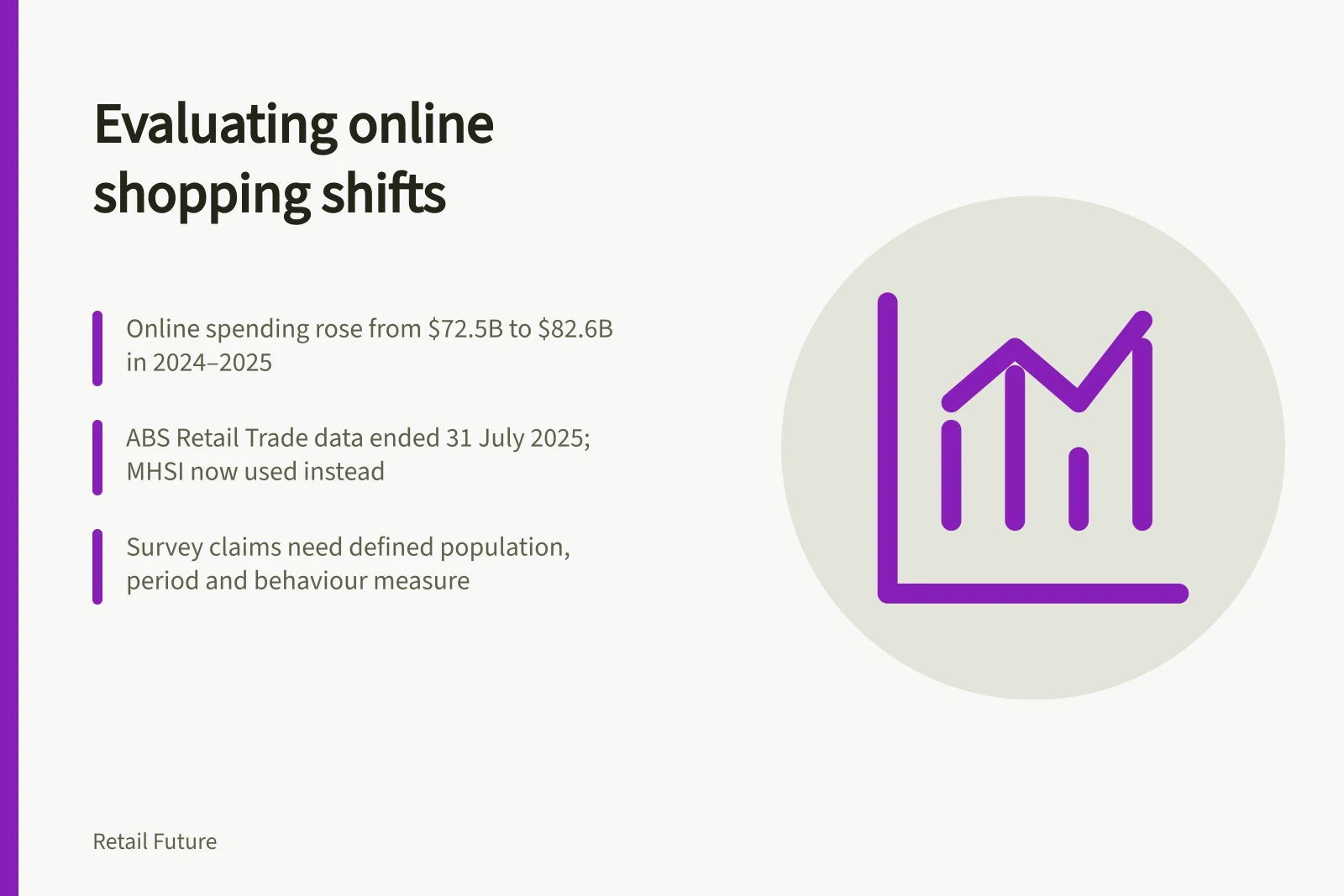
Australia Post reported $82.6 billion in online spending in 2025, up 14% from 2024, citing CommBank iQ data. This is evidence about that reported dollar measure. It does not show that every category gained online sales, that physical stores lost the same sales or that more items were bought.
A separate Australian Retail Council item reports Australian Retailers Association–Roy Morgan research on back-to-school spending. Without a comparable population, period, behaviour and unit, it cannot establish a channel shift against an annual spending total.
Key Online Spending Figures in Australia (2024–2025)
- 2024Online spending — $72.5 billion
- 2025Online spending — $82.6 billion
- 14%Year-on-year increase
Check comparisons in order
- Population:Are comparable shoppers, businesses and locations represented?
- Behaviour:Is the question or transaction definition unchanged?
- Period:Are the dates and seasonal occasions comparable?
- Coverage:Did the survey sample, store network, payment source or platform change?
- Value versus activity:Did purchase counts change, or only dollars spent or average basket?
- Uncertainty:Could sampling error, revisions or recording limits affect the claimed change?
If a definition or source changes, show the observations separately and explain the break. Do not turn unlike measures into a trend.
State the narrow conclusion
The Australia Post figures support a rise in reported online spending from $72.5 billion in 2024 to $82.6 billion in 2025, but do not establish that more shoppers bought online or that store visits fell.