Shopper Research
Part of Retail pricing behaviour
Evaluating the evidence behind value-seeking consumer claims
“Customers are looking for value” is plausible in many periods but too broad to explain a buying decision. Ask what “value” means in the claim: lower upfront price …
“Customers are looking for value” is too broad to explain a buying decision. First pin down what the claim means: a change in purchases, stated priorities, prices, product life, trips or reliability.
Match the evidence to the claim. Ask whether it measures what people bought, what they said they wanted, the prices available or problems reported after purchase.
| Evidence | What it can show | What it cannot prove alone |
|---|---|---|
| Sales and basket data | What was bought in a defined store or channel | Why a customer chose it |
| Survey responses | Stated priorities of respondents | Actual behaviour of all shoppers |
| Price comparisons | Available offers at a point in time | Product equivalence or future prices |
| Return and complaint data | Reported problems after purchase | Full product quality for every buyer |
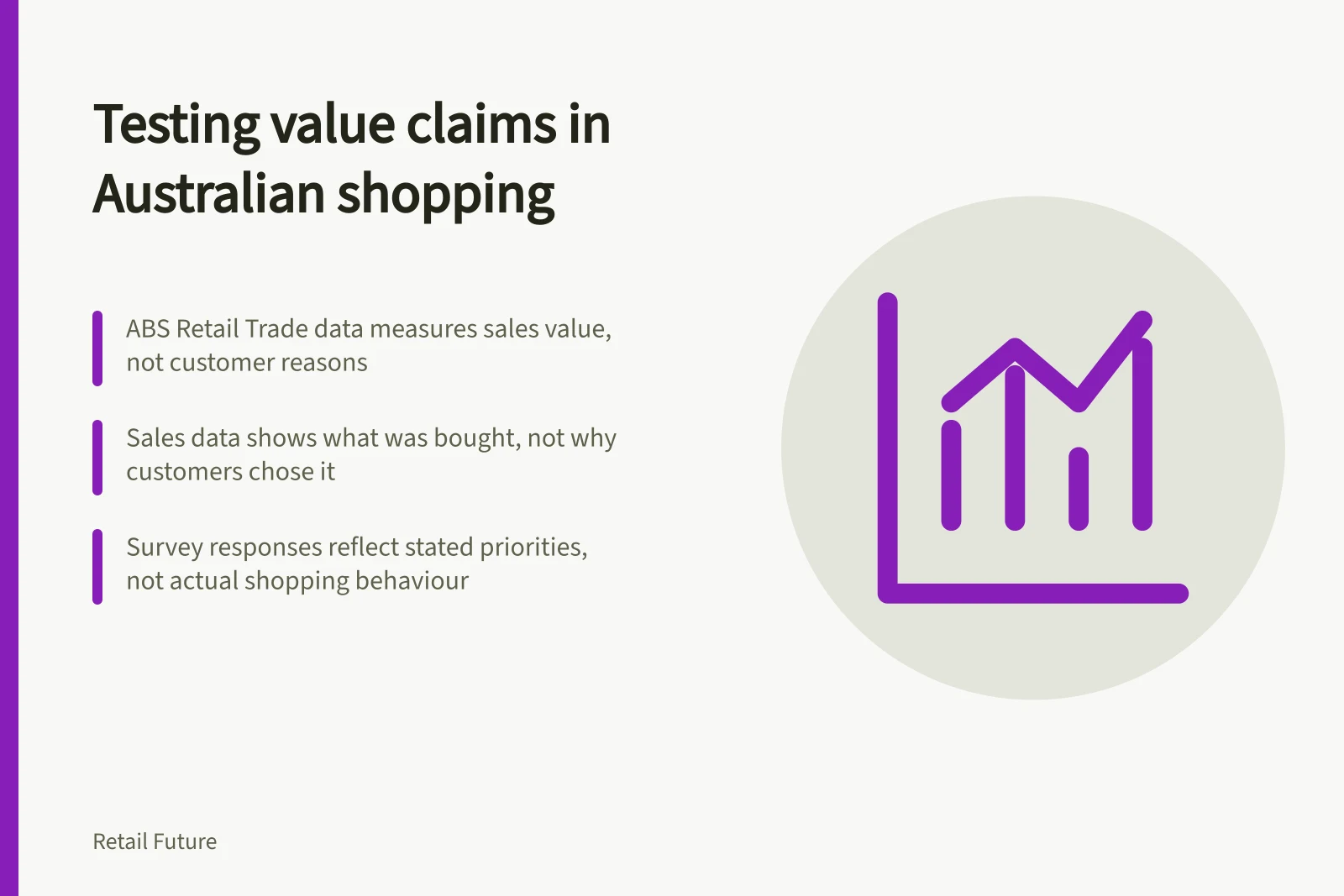
For a named Australian measure, start with the ABS publication Retail Trade, Australia methodology, April 2025. It estimates turnover for employing retail businesses that predominantly sell to households, with results for Australia and states and territories. Turnover measures sales value, not why customers bought something.
The ABS survey is monthly: about 700 large businesses are included and a random sample of about 2,700 smaller businesses is selected. Large businesses contribute approximately 69% of the total estimate, supporting a highly reliable Australian total turnover estimate; that does not establish an individual shopper’s choices or motives.
The ABS Guide to the Consumer Price Index: 17th Series describes the CPI as a quarterly general measure of price changes for consumer goods and services purchased by Australian households. It can provide price context, but does not show what shoppers bought or why.
The ACCC’s Supermarkets inquiry 2024–25 final report, released on 21 March 2025, drew on consumer survey responses, information from retailers and suppliers, public and private hearings and submissions, and roundtable feedback. It also presents a commissioned report on decision-making and the behavioural impacts of supermarket pricing, promotional programs and loyalty program practices.
Apply the test to “Customers are looking for value”: the inquiry’s consumer survey can speak to respondents’ stated views, while its other evidence streams address different aspects of the supermarket inquiry. The listed evidence streams alone do not establish that shoppers’ behaviour changed or that value was the reason.
Next check the period, geography, category and sample behind each result. Ask whether stock availability, a promotion, pack sizes or shopper mix could explain the pattern; these are alternative explanations to account for, not evidence of motive.
Give most weight to evidence that directly measures the claim, matches its category and period, and states its sample and method. Treat a survey as evidence of respondents’ reported views, and sales turnover as evidence of sales value; qualify conclusions when those measures do not establish the claim being made.
Do not substitute an unsupported threshold for missing detail. Report the measure, period, geography and sample that are available; if a key detail is not reported, narrow the conclusion rather than implying greater certainty.
For public displayed-price claims, check the ACCC’s Price displays guidance: the ACCC can investigate breaches of price-display rules. For grocery unit-price claims, the ACCC enforces the mandatory Unit Pricing Code; its Unit prices for groceries guidance explains its role.
State the conclusion at the level measured: “In this category and period, [measure] changed.” Add a claim about why shoppers acted only when evidence directly supports that reason, and recheck the pattern before changing an assortment or making a public claim.
Key Australian Data Sources for Evaluating Value Claims
- ABS Retail Trade Methodology (Apr 2025)Monthly turnover estimate for employing retail businesses selling to households; includes ~700 large and 2,700 small businesses
- Consumer Price Index (17th Series)Quarterly measure of price changes for goods and services purchased by Australian households
- ACCC Supermarkets Inquiry Final Report (Mar 2025)Findings from consumer surveys, retailer and supplier input, hearings, submissions, and behavioural analysis on pricing and loyalty programs
- ACCC Unit Prices for Groceries GuidanceEnforces mandatory unit pricing code; provides guidance on accurate grocery price displays
Timeline of Key Evidence for Value-Seeking Consumer Claims in Australia
- April 2025ABS releases updated methodology for Retail Trade, Australia
- March 2025ACCC releases final report from the Supermarkets Inquiry 2024–25
- OngoingACCC enforces Unit Pricing Code for groceries and monitors price display compliance