Shopper Research
Part of Interpreting published retail shopper research
Distinguishing transaction evidence from stated shopping preferences
Separate what shoppers say from what transaction data records, and avoid treating aggregate differences as proof of individual motives.
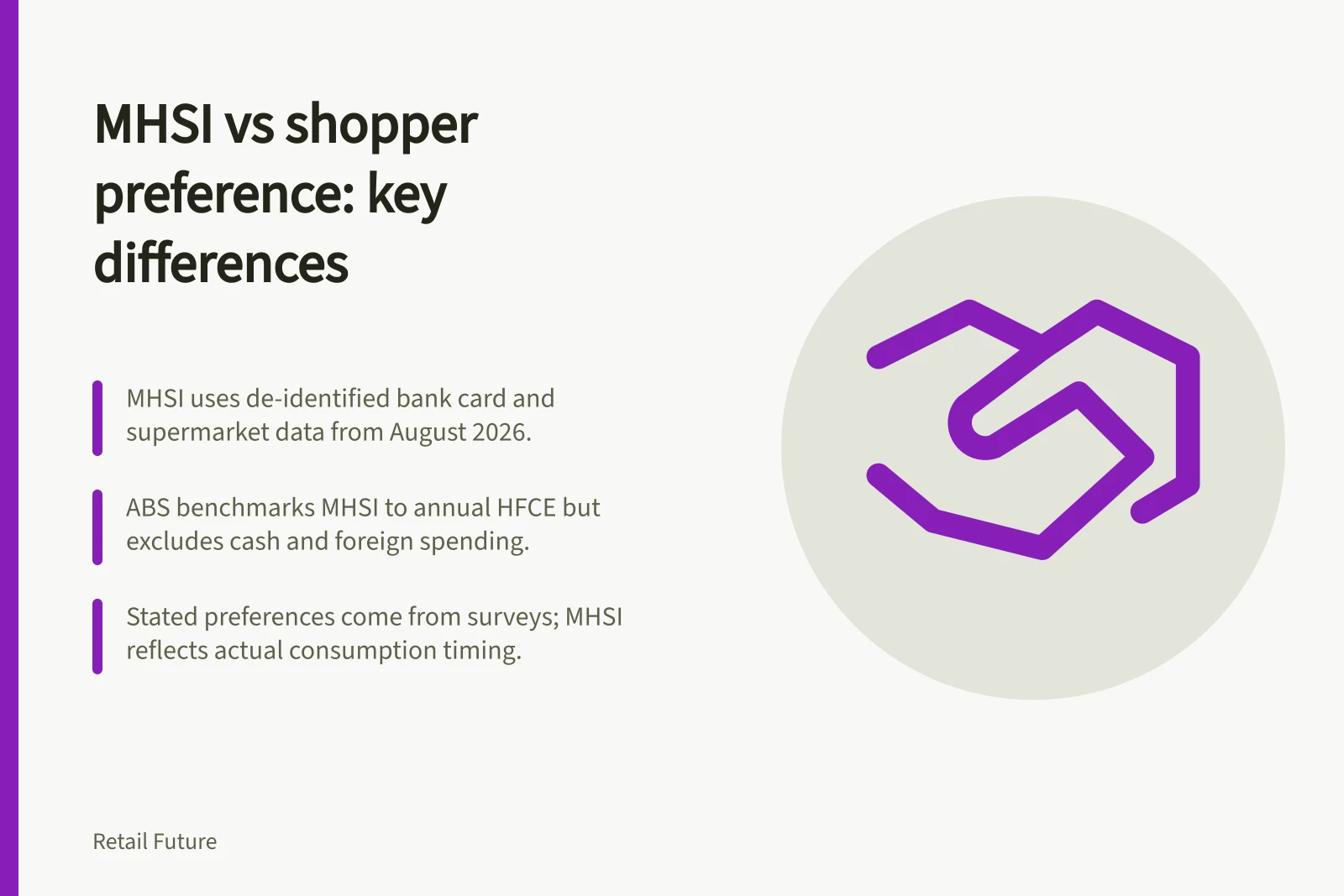
A published shopper-preference claim records what respondents say; the ABS Monthly Household Spending Indicator (MHSI) records household consumption in aggregated, de-identified transactions and related data. These are different measures. Compare them only after aligning the claim’s population, period and measure with the MHSI’s stated scope.
Identify the behaviour each source captures
For a stated preference, identify the named survey or study, its respondents, the question, the period and the reported result. These details show whether the claim measures stated importance, intention or another response. If a detail is not reported, leave it unknown rather than infer it.
The MHSI methodology identifies no shopper-preference question, response or result. It defines the measure as final consumption of goods and services by Australian households, guided by UNSD COICOP and aligned with National Accounts HFCE categories and concepts.
MHSI outputs cover 9 COICOPs, Australia, states and territories. For reference period August 2026, consumption is assigned to the period the good or service is consumed rather than the period it is paid for when those periods differ.
Check for a mismatch before explaining one
The MHSI is derived from aggregated, de-identified bank card transactions provided by participating banks, supermarket transactions and new vehicle sales. Banks send transaction data soon after month end; supermarkets send weekly transaction files, and VFACTS is delivered monthly by the Federal Chamber of Automotive Industries (FCAI). The methodology does not name the participating banks or supermarkets.
The ABS August 2026 MHSI methodology page lists a reference period of August 2026 and a release date of 29 September 2026 at 11.30 am AEST. It also states that outputs from 9 COICOPs and all states and territories are published.
MHSI data are not designed for statistical purposes, and their scope varies from both Household Final Consumption Expenditure (HFCE) and Retail Trade turnover. The MHSI is benchmarked to annual HFCE and adjusted monthly for data gaps such as cash spending.
MHSI data sources do not capture spending by Australian residents on goods and services offered outside Australia, or expenditure incurred by resident non-profit institutions serving households, which is included in HFCE. Bank card data also exclude foreign-currency transactions where the card terminal is outside Australia, so check whether a preference claim covers a different population or range of spending.
Westpac IQ’s 28 May 2026 report says the April household spending indicator fell 1.1% month-on-month and was 4.9% year-on-year. It attributes most of the monthly decline to an unwind in auto-fuel-related spending, mostly price-led, while estimates of spending volumes picked up.
The monthly fall and positive annual rate compare different periods; neither is a preference score. Westpac IQ also reports that higher jet-fuel prices contributed to lower transport-services spending, with households scaling back travel plans and some airlines cancelling flights. Those reported spending movements do not establish an individual shopper’s stated preference or motive.
ABS Monthly Household Spending Indicator (MHSI) – August 2026 Snapshot
- Reference Period
- August 2026
- Geographic Coverage
- Australia, states and territories
- COICOP Categories Covered
- 9 COICOPs
- Benchmarked To
- Annual Household Final Consumption Expenditure (HFCE)
Key Dates in MHSI Data Processing and Reporting
- Bank Transaction Data Submission
- Soon after month end
- Supermarket Weekly Files Submitted
- Weekly during September 2026
- VFACTS Vehicle Sales Data Delivered
- Monthly by FCAI (September 2026)
Report what the combined evidence permits
Attribute a stated preference to the published claim and describe the MHSI result separately, with its category and reference period. A difference between the two is not proof that shoppers acted against a preference: the measures may cover different populations, periods or concepts.
An aggregate MHSI result cannot show whether an individual acted on a stated preference. Describe an individual preference–behaviour gap only if the same consenting respondents’ answers and purchases have been linked; check the link rate, observation window and missing transactions.
The ABS defines response error as respondents intentionally or accidentally providing inaccurate responses. It can occur when concepts, questions or instructions are unclear, respondent burden or memory recall is high, or answers tend towards social desirability. Treat these as possible limits when interpreting a stated result, not as proof of a purchase motive.
Limitations of Stated Preferences vs. Transaction Data
- Pros of Stated PreferencesCaptures intentions, motivations, and perceived importance; useful for understanding shopper mindset.
- Cons of Stated PreferencesProne to response error due to unclear questions, memory recall, social desirability bias, or respondent burden.
- Pros of Transaction Data (MHSI)Reflects actual household spending; minimises self-reporting bias; covers large-scale aggregated behaviour.
- Cons of Transaction Data (MHSI)Does not capture cash spending, foreign transactions, or non-resident spending; not designed for statistical inference at individual level.